By Naylin Appanna / February 22, 2026
Highly regulated environments operate within governance structures that are significantly more complex than those found in most commercial settings. Legal oversight, regulatory accountability, reputational exposure, and operational performance intersect in ways that create layered governance architecture.
Public perception of organisational performance often appears binary — success or failure. Governance reality is considerably more nuanced. Regulatory intensity, institutional accountability, and reputational sensitivity combine to create oversight conditions that differ substantially from conventional enterprise management.
Organisations operating within regulated environments must simultaneously manage:
- Regulatory compliance
- Operational standards
- Professional accountability frameworks
- Privacy and data protection obligations
- Financial sustainability
- Public and stakeholder trust
Each layer operates under independent oversight mechanisms and on different timelines. Regulatory frameworks evolve through legislative processes. Operational standards develop through industry bodies. Privacy obligations adapt to technological change. Financial pressures fluctuate with economic conditions.
These layers rarely move in synchrony.
When governance systems remain aligned, stability follows. When misalignment develops, pressure can accumulate quietly before becoming visible.
Layered Oversight Structures
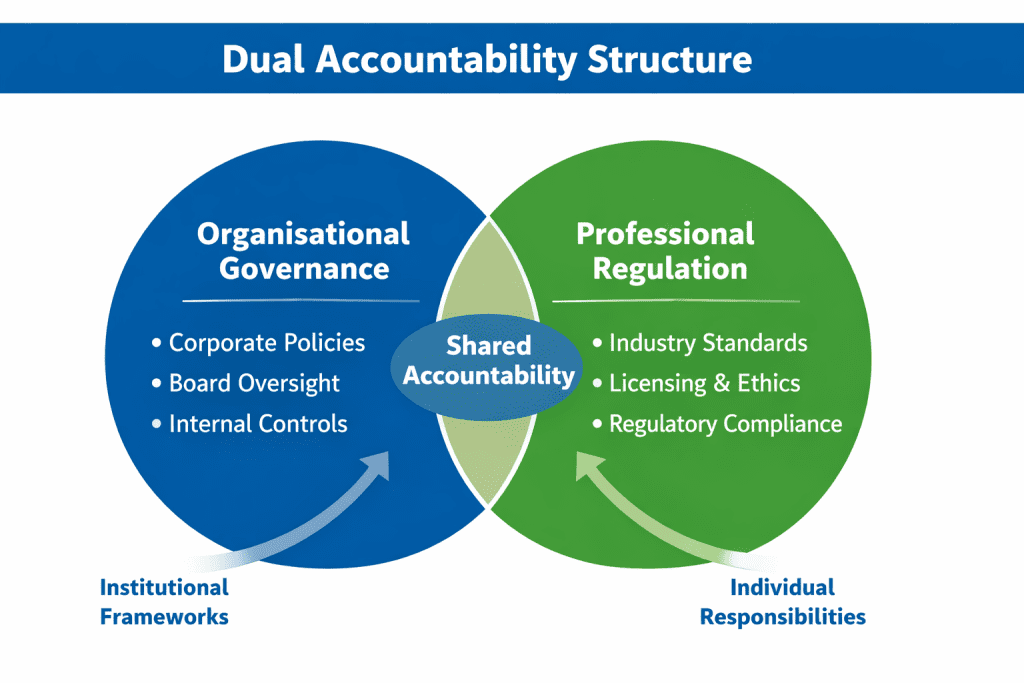
Figure 1. Dual accountability structure in regulated environments showing the interaction between organisational governance and regulatory oversight.
A defining challenge in regulated environments is the relationship between individual professional responsibility and organisational governance.
Many regulated sectors operate under systems where individual practitioners remain accountable to independent regulatory frameworks while simultaneously working within organisational structures. Corporate governance alone is therefore insufficient to manage risk.
This produces a dual accountability structure consisting of:
- Organisational governance frameworks
- Individual professional or regulatory obligations
Boards and leadership teams must ensure institutional systems support regulatory expectations without undermining operational effectiveness. Conversely, professionals operate within regulatory frameworks that may not always align perfectly with organisational pressures.
Maintaining equilibrium between these layers requires clarity of role definition, documented accountability pathways, and early escalation mechanisms.
Documentation and Procedural Discipline
In regulated sectors, documentation is not administrative overhead — it is structural protection.
Clear records support:
- Audit readiness
- Regulatory response
- Risk identification
- Escalation transparency
- Institutional continuity
Where documentation discipline weakens, governance fragility increases. Informal systems may function during stable periods but often fail under stress conditions.
Durable governance therefore requires deliberate documentation architecture. Policies must operate as living systems rather than static documents. Escalation procedures must function early rather than retrospectively.
Independent review mechanisms are equally important. Internal review processes that lack structural independence can become procedural rather than analytical. Effective governance systems create room for objective scrutiny before reputational consequences escalate.
Reputational Velocity
Regulated environments operate under heightened reputational sensitivity. Allegations, regulatory inquiries, or compliance reviews — regardless of eventual outcome — can generate impact disproportionate to operational scale.
Governance structures must therefore anticipate not only operational risk, but reputational velocity.
In the digital environment, information circulates rapidly. Media coverage, institutional communications, and public commentary can converge within short timeframes. Organisations must therefore respond procedurally rather than reactively.
This requires:
- Defined communication protocols
- Clear responsibility assignment
- Structured public response frameworks
- Early legal and regulatory coordination
Organisations that improvise governance responses during moments of pressure frequently amplify instability.
Culture and Compliance
Another governance challenge lies in balancing cultural health with regulatory compliance.
Excessively rigid regulatory systems without proportionate organisational design can produce defensive cultures. Conversely, insufficient governance invites structural vulnerability.
The objective is not maximum rule density. It is calibrated governance — systems proportionate to risk exposure.
Effective leadership within regulated environments promotes:
- Procedural clarity
- Early escalation norms
- Constructive peer review
- Accountability without hostility
Achieving this balance requires continuous calibration rather than static policy frameworks.
Proactive Governance Architecture
Durable governance systems are proactive rather than reactive.
Organisations that operate within complex regulatory environments must stress-test their governance structures before operational pressure emerges. Systems redesigned during crisis rarely achieve stability quickly.
Organisations that endure treat governance not as compliance overhead but as structural architecture.
Regulation is not an external burden. It is part of the operating environment.
Where governance maturity is embedded, resilience follows.
In regulated environments, calm systems outperform reactive responses.
Durability is procedural before it is reputational.
About the Author
Naylin Appanna writes on governance systems, regulatory environments, and organisational resilience. His work examines how institutions manage accountability, operational complexity, and reputational risk across regulated and commercial sectors.