By Naylin Appanna
Introduction
Reputation risk management has changed fundamentally in the digital era. Information now spreads at a speed that outpaces traditional governance and crisis response systems, creating what can be described as information velocity.
Reputational exposure is no longer determined solely by events themselves, but by how quickly narratives form around them.
Organisations that fail to adapt to this reality often find that response strategies designed for slower environments are no longer effective.
What is Reputation Risk Management?
Reputation risk management refers to an organisation’s ability to anticipate, monitor, and respond to threats that may affect stakeholder perception.
Traditionally, reputational issues developed over extended periods. Today, they can emerge and escalate within hours.
This shift requires a fundamentally different approach to governance.
The Impact of Information Velocity
Information velocity describes the speed at which information moves across modern communication channels.
This acceleration is driven by:
- digital media platforms
- real-time public commentary
- regulatory disclosure requirements
- internal information leakage
- algorithm-driven content distribution
These forces compress the timeframe available for response.
Governance systems that assume slower information cycles are increasingly misaligned with operational reality.
How Narratives Form in a Crisis
Reputation is shaped not only by facts, but by narratives.
When information is incomplete, narratives form rapidly. Early interpretations often become the framework through which subsequent information is understood.
Silence, while internally appealing, creates space for external interpretation.
That space is rarely neutral.
The Reputation Response Framework
Effective reputation risk management depends on coordination across three core domains:
- Monitoring – identifying emerging signals
- Interpretation – analysing implications across legal and operational contexts
- Response – determining communication and action strategies
When these domains operate independently, delays occur. When they are integrated, organisations maintain control over narrative direction.

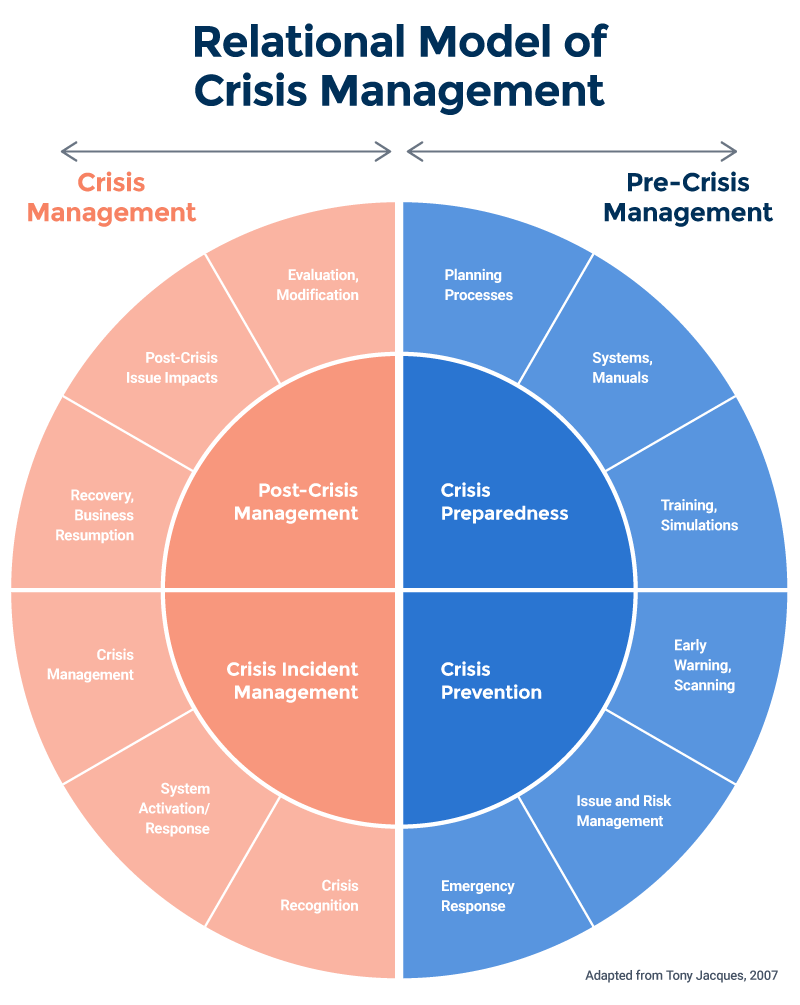

4
Figure: Reputation risk framework showing the integration of monitoring, interpretation, and response.
Governance and Board-Level Responsibility
Reputation is a governance issue, not just a communications function.
Boards and leadership teams are responsible for:
- defining crisis communication protocols
- establishing decision authority during reputational events
- ensuring alignment between legal, compliance, and communication teams
- maintaining external stakeholder relationships
These structures must exist before a crisis occurs.
Procedural Preparedness in Crisis Management
Prepared organisations respond with clarity. Unprepared organisations react.
Procedural preparedness includes:
- predefined communication pathways
- documented escalation thresholds
- designated spokesperson authority
- coordination between legal and communications functions
Without these elements, response becomes fragmented and inconsistent.
How Organisations Lose Control of Narrative
Organisations typically lose control of narrative in predictable ways:
- delayed acknowledgement of issues
- inconsistent messaging across departments
- over-reliance on internal verification before external response
- lack of coordination between leadership and communications teams
These failures are structural rather than situational.
Maintaining Narrative Stability
Narrative stability depends on the ability to respond at the speed of information flow.
This requires:
- real-time monitoring systems
- rapid interpretation frameworks
- clearly defined response authority
Where these systems operate together, organisations maintain control even under scrutiny.
Where they do not, narratives evolve independently of organisational input.
Conclusion
Reputation risk management is no longer a slow-moving governance function. It operates at the speed of information.
Monitoring, interpretation, and response must function as an integrated system capable of keeping pace with modern communication dynamics.
Organisations that recognise this shift maintain narrative stability.
Those that do not often find themselves responding to a story that has already been written.
About the Author
Dr Naylin Appanna is a former specialist obstetrician and gynaecologist with extensive experience working within regulated environments. His work focuses on governance systems, reputational risk, and organisational resilience.